Monday, March 30, 2015

Draft of Problem Statement

The problem I have come up with for my paper is: many people underestimate or are not aware of the importance of carbohydrates for muscle growth when doing resistance exercise. Usually people think that proteins are the most important thing to consume a large amount of when exercising, but carbohydrates are just as important.

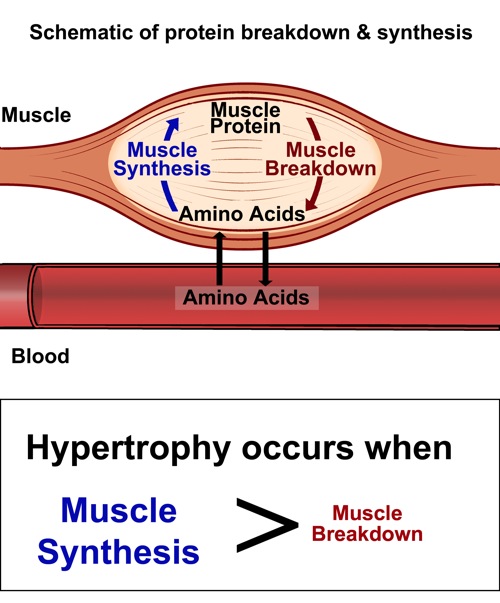
Here is a visual of muscle protein synthesis. Note: hypertrophy is another word for muscle growth.
Link to this webpage: http://www.precisionnutrition.com/wordpress/wp-content/uploads/2009/06/figure-1-protein-turnover-b-copy.jpg

Carbohydrates fuel muscles for resistance exercise, decrease muscle protein breakdown during exercise, and benefit muscle recovery when ingested with proteins or amino acids. As I mentioned in my last post, glycogen stores in muscles are the stores of carbohydrates in muscle tissue which provide the energy for people to put the most effort into their workout. Since carbohydrates are our most quickly and often metabolized source of energy, it is best to have plenty stored in muscles because, if there isn't enough, your body will start to burn proteins for energy (muscle protein breakdown). Carbohydrates also help fuel processes to carry amino acids to muscle tissue for the rebuilding and recovery of torn muscles.

Note: See my previous blog post for definitions of bolded terms.

Defining Your Terms

Terms often have a variety of different meanings to a variety of different people. Someone in one field may interpret a term one way, while those not in the field or in a different field think about it in a completely different way. This is why it is always important to define the terms you are using in writing. That way, the reader will be able to understand what you are writing in exactly the way you intend it to be interpreted.

Note: I have decided to change my research topic. I was having trouble finding evidence to support my past claim, so I have decided to focus on writing about the importance of carbohydrates when it comes to muscle growth and athletic performance in the gym.

In my paper, I plan to define muscle protein synthesis, muscle protein breakdown, complex carbohydrates, simple carbohydrates, muscle recovery, glycogen stores, muscle growth/hypertrophy, amino acids, and proteins. I will just discuss them as they come up in my writing so the readers understand what those terms refer to and how they all connect. These terms matter because they are used very often in my field and the average person may not understand what those are or what they mean in relation to the context of my paper.

Here is a model of a glucose molecule, which is the sugar that makes up carbohydrates.
I found it at this web address: http://www.bio.miami.edu/dana/pix/glucose.gif


Muscle protein synthesis (MPS): the production of muscle proteins for muscle tissue. This can lead to muscle growth.

Muscle protein breakdown (MPB): the breakdown of muscle proteins in muscle tissue. This can lead to loss of muscle mass.

Complex carbohydrates: Carbohydrates that are more difficult for the body to break down and act as a stable, longer term source of energy. These are found in foods like sweet potatoes, whole grains, brown rice, quinoa, etc., and stored in muscles as glycogen.

Simple carbohydrates: Carbohydrates that are very easy for the body to break down and provide a short burst of energy for the body, often found in processed foods such as white bread, white rice, and white pasta. These carbohydrates are not stored in muscles.

Muscle recovery: The rebuilding and healing of torn muscle tissue after resistance exercise.

Glycogen stores: Stored carbohydrates in muscle tissue.

Muscle growth/hypertrophy: The result of muscle protein synthesis and proper recovery which occur from exercise and nutrition.

Amino acids: The monomers (building blocks) of proteins.

Proteins: A macromolecule, along with carbohydrates and fats, that is composed of amino acids.

Tuesday, March 17, 2015

My Writing Process

When I actually get around to writing, the process is very long and stressful. I often get extreme writer's block and then I'll have a moment where I can type for a half hour straight without stopping. I also talk about my subject with my mom a lot because she is better at coming up with ideas than I am and she knows a lot about, I'd say, everything.

Something else I tend to do is look for any sort of excuse to get up and do something besides what I am supposed to be doing. Maybe I'll start watching TV (because it's usually on and in the same room at the computer) or go to the kitchen when I am really not hungry or check my phone or send some random Snapchats about how I need to be doing my homework, ironically enough.


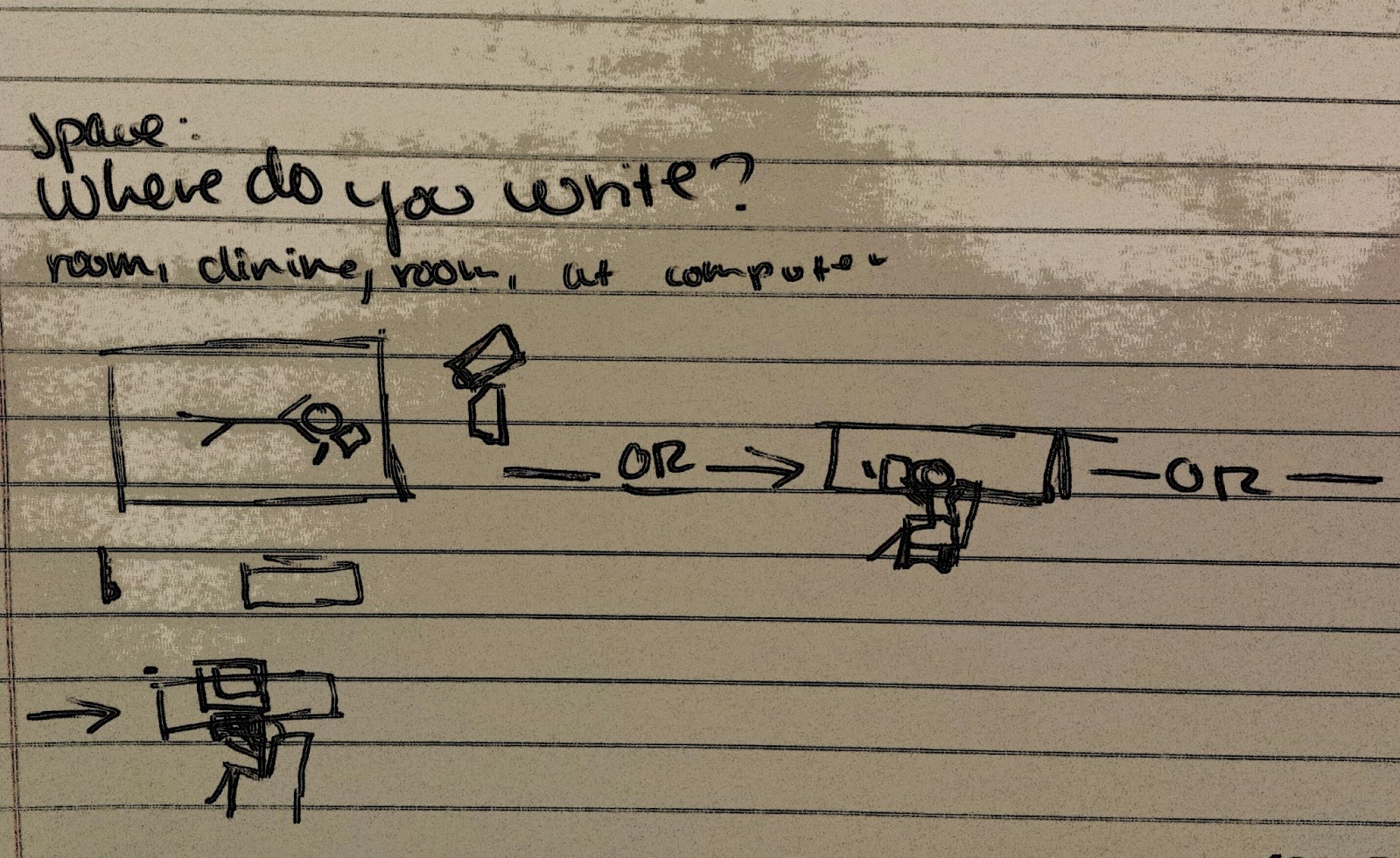
 The picture above is a messy representation of where my writing process happens. I spend a lot of time thinking, planning an outline, and collecting evidence so I am not left in the middle of typing my paper and not clear on how I am going to back up my statements. I like doing this because I can relate English to math: it's like a formula. All you need to do is create your intro, body paragraphs, and conclusion and list the points you want to make in each paragraph. From there you can write your paper smoothly while knowing exactly what you want to say.

I like to do this in a place I am comfortable or around some other people to help me brainstorm. First I show a picture of me on my bed with a notebook attempting an outline, next is me at the dining room table which is closer to where my family is, and the last is a picture of me at the computer, which shows me actually typing my paper.


This second picture shows how I write, in steps similar to those pictured but probably in a variety of orders. First I am shown on my bed brainstorming; I often think I have a good idea, but then as I think more I just end up confusing myself and having to come up with another idea. The second picture shows notes I take, describing the possible outline, layout, evidence/supporting info, and sentence fragments for and to use in my paper.

The next two sketches show me at the computer sighing, typing, and deleting, as I always have trouble getting started or end up with three different intros I could use. Then I talk to my mom for ideas and can actually figure out something substantial to write.

Soon after I decide to distract myself and procrastinate for a while by watching TV. After that I will get tired and refuse to work anymore, so I sleep and wake up and the process starts all over again, eventually resulting in my finished paper.

Here is the link to the essay I read regarding writing processes: http://vizedhtmlcontent.next.ecollege.com/CurrentCourse/priorandshipka.pdf

Research "Problem"

I believe the problem I am looking to discuss in my research is that regarding advertisements for new exercise programs making false claims about the results they will supposedly give you. 

There is always some new product or set of DVDs the advertisers are trying to convince us to buy when we know they are all the same. However, when we start watching them, that specific one seems to stand out because it was created by doctor so-and-so, or it includes something that makes it unique.

In my paper I would like to identify the issues with all of these false claims and explain what some of those specific claims are and explain why they are incorrect and how they can be harmful to those making purchases or practicing what is told to them.
This is not necessarily one of the programs I will discuss in my paper, but it is an example of an exercise program advertised on TV with the same claims as many other programs.


Monday, March 16, 2015

Ted Talk Response: "Txtng is Killing Language. JK!!!"

Many have said before that texting impairs peoples' ability to write in standard American English as English classes require. In the Ted Talk "Txtng is killing language. JK!!!" John McWhorter identifies that texting is not in fact writing, but "fingered speech." 

He supports this by stating that writing was invented to get a point across to a certain audience in a very formal way, whereas many people text in the way that they speak. Also, new words, slang, and terminologies have arisen and evolved through texting. 

The only issue I had with McWhorter's presentation is that he provided texting samples that did not seem very accurate, or slang that my class mates and I had never heard of before watching his presentation. For example, everyone I know spells out words for the most part and does not attempt to leave every letter out they possibly can to shorten their message (like the example to the left), which is what he presented to be closer to the truth. My friends and I simply tend to write with our own personal lingo and expressions to make the texts readable in a way most similar to how they would sound if we were speaking those words ourselves.

Language is constantly changing, with new slang and word usages and even just brand new words that were created to identify recently invented or popularized objects, games, TV shows, acts, and many other things as well. Because of this, it is not necessarily fair for someone to say that someone else is speaking 'incorrectly' simply because it is different. 

As many linguists have identified, standard American English is not the "correct" way of speaking, but rather only one type of english. There is African American English, British English, and many other types of english that are valid languages spoken in a variety of places around the world with different terms and ways of spelling the same words.

I know that I have a certain way of speaking myself, which changes depending on the environment I'm in. At school I do not tend to use my personal way of speaking, but try to keep it more academic and appropriate for the environment, as I am not with my friend or family but in public. In a school or work setting people want to be treated with respect, and that will not happen if they break certain boundaries, such as using too much profanity or speaking in such a way that your teacher and/or peers can no longer understand what you're saying because there is so much personal slang involved.

Personally, when I am at home I shorten half of my words so I am only pronouncing the first one or two syllables. If I did that at school I am pretty sure people would think there was something wrong with me and be confused about what I was trying to say, but at home I am with my friends and family and they understand what kinds of things I say and the meaning and context behind them.

In a professional environment it is safest to stick to common expressions recognized by most age, racial, and cultural groups and keep standard American English grammar errors to a minimum when speaking. Just because someone uses made up words and slang at home or with their friends definitely does not mean that he or she does not know standard American English, but rather that the individual understands the parameters in which it is necessary and appropriate to use. 

Saturday, February 14, 2015

Research & My Bibliography: 'Genres'

For my annotated bibliography project, I probably looked at a wider variety of sources than I have ever had to for any type of research previously. A large part of this is because I now have access to a database that I used to find almost all of them. While doing my bibliography, I really noticed the differences between different 'genres' (i.e. newspaper article  vs blog). Altogether, I used peer-reviewed articles, blogs/blog posts, newspaper articles, and a professional website in my bibliography.

The most helpful type of source probably has to be peer-reviewed articles. Some were purely discussing a study that was conducted, and others talked about the studies of individuals that were taken into account to formulate and support newly presented ideas. They are lengthy and use a lot of terminology, but the 'abstract' of the article is very helpful in summarizing the findings and/or conclusions of the authors. These are the best type of source in my opinion because they are purely based off of actual research findings instead of opinion or common belief. If they contain visuals, they consist of graphs and charts.

This shows the typical layout of a peer-reviewed article.

Blog posts were helpful too, but this a much less reliable source than a peer-reviewed article may be, at least from the scientific aspect of things. I say this because those writing about something exercise-related are probably making those claims as someone who has actually experienced the affects of whatever he or she is discussing, but not know the science behind them. Blog posts vary in length depending on the author, but for the most part they are shorter than peer-reviewed articles. These aren't always based off of fact, usually with the author voicing their opinion on a subject because they have the freedom to, and there are rarely any facts or statistics mentioned to support the claims made in blog posts. Obviously there is much less terminology in a blog post than in a scholarly publication as well, making it a more friendly genre to the everyday person searching the internet. Blog posts have a lot of visuals in them, too.

Blog post paragraphs are often short and to the point, as shown in this visual.


Newspaper articles had to be the least useful in my research. They do vary in length, but the ones I found were very brief. Newspaper articles tend to touch on a lot of different subjects with vague detail. Strong claims are often made, again with the credibility of the author and statement under question. They are similar to blog posts in that they are meant for the everyday person, but newspaper articles are much less personal than blog posts can be. Short articles don't usually have pictures.


I could really only find one professional website, which I identified by the URL ending in "edu." Websites like this often contain what I suppose one could call 'articles' regarding certain subjects that are often written by professors, making them a credible source just as peer-reviewed articles. Depending on the type of article you are viewing in the website, it could either be long or short. Some contain visuals as well, but mainly graphs or charts.

This project has really helped me identify efficient ways too find credible sources for future research. I think the issue was that before I simply didn't know how to research something aside from doing a Google search on it. Now I understand a wider variety of genres and what they can offer to the readers.

Exercise Science & EMU Faculty Members

I was required to find someone who works at Eastern Michigan University in an area of study similar to that of my interests. The closest major available here that applies to what I am interested in is probably Exercise Science, which consists of learning about subjects such as physiology/anatomy, biology, chemistry, and so on.


One of the first people I came across on the school's website was Anthony Moreno, who is the undergraduate program coordinator of Exercise Science at EMU, as well as a professor. His interests are most applicable to mine out of the main Exercise Science faculty, however I do not think any of his publications are relevant enough to my research topic for me to use them. 

It stood out to me that one of his interests is strength training and preventing sports injuries for youth because strength training is my focus as well. On Moreno's page in the directory, it also stated that he is interested in "the role of motor skill ability on physical activity throughout the lifespan."

A second faculty member I found, named Becca Moore, is an assistant professor at EMU. She took part in writing an article titled "Carbohydrate and protein hydrolysate coingestions improvement of late-exercise time-trial performance." At first I thought this might be useful for my research, but it was not applied to weightlifting, MPS, and hypertrophy, but rather the effect of the coingestions on a cyclist. I have come across the term 'coingestion' with protein and carbohydrates while doing research for my topic, so this may help me understand the relevance of coingestion in regards to exercise overall.

Looking at these profiles along with those of the other faculty members, it seems that there is a wide range of things to look into regarding Exercise Science: coingestion, obesity, cardiovascular exercise, how muscle changes as individuals get older, topics regarding muscular diseases, and the list goes on. I am disappointed that I wan't able to find someone at EMU with research interests that directly correlate with mine, but Exercise Science is definitely relevant to my topic. Obesity is something I think I would like looking into so I can better understand the physical state that is opposite of the one I am currently focused on, plus it is such a growing problem in the United States and other places around the world.